Showing posts with label Frank Chadwick. Show all posts

Sunday, March 9, 2025

Striker 1e: Informed Amendments

"We're ready to have a good time with this game, Sir...
...if you can just get the mechanics to run a bit smoother!"

Well, the staff here has been working hard on just that, so let's see what we have...

I consider these "informed amendments" as these changes are mostly oriented around achieving a certain type of game flow, with certain technology, etc, after numerous playtests and close examination of the rule mechanics - including the math! Pictured below are numerous Fire rolls by a Team, to see results and if those results deliver the right "feel":
Goal1 with this permutation of Striker 1e on the table, was to use a TL that was more or less contemporary to test the "feel" that the game mechanics could provide.

The gauge for this was to balance all the variables [many variables...] for a result that 2 Teams Firing would usually force a Target team to  take a Morale Check with a 50% chance of  a "Suppressed" result. Pulling back to TL 9 and down put Striker 1e into my understanding of late Cold War conflicts and Iraq / Afghanistan, which made it easy to test "feel" in Striker 1e.


Goal 2. Striker 1e is a military / wargame supplement for an RPG system. It is therefore not immediately apparent how to throw a balanced game that fulfills the host's intentions - whether they are for a traditional 1-off Wargame, or part of the plot line of an ongoing Traveller 1e campaign.  I'm interested in understanding how to do either one, since I regularly host both an ongoing T1e campaign and 1-off wargames. Also, I have the miniatures needed for several historical and futuristic settings.  

So, I wanted to write up a short sheet of directions explaining how to set up a balanced game, complete with comparison of forces and terrain use, to hopefully achieve the goal.

Goal 3. Test the culture clash between RPGs v. Wargames that S1e sits astride.

RPGs often work at a relatively small level, and are much more personal than a wargame. So a typical Traveller campaign would likely have several characters and NPCs working in / with a small unit, probably just a squad or two, for an "encounter" that could be resolved with the T1e Book 1 & 3 encounter mechanics in a reasonable amount of time, say three hours. 

The closest that Wargaming gets to this is usually skirmish wargaming, perfectly exemplified by the Larry Brom classic "The Sword & The Flame", which encourages you to play about 20 figs a person and give each Soldier a name! More typical, especially today, is for a higher level of combat to be played, often a full company per player with a platoon as a "Game Unit". This is perfectly exemplified by the popular "Flames of War" WWII wargame, and its many derivative competitors. Altho a 1:1 scale game [where 1 fig = 1 Soldier, 1 vic = 1 vic], FoW leaves all those chaps as anonymous faces on the table, with only 1-2 heroic types a side being named and considered as individuals.

--> a subsidiary spin-off today is the small skirmish game that is similar in mechanics to the above FoW abstraction level, with small forces that are named.  As a fast-play narrative driven game, these are increasingly popular. 

There are a bunch of S1e game mechanics that are there to provide detailed information, mostly combat results, about every Soldier, crewed weapon, and vehicle. All of which is just fine for an RPG, where you are *most likely* going to be running a smaller fight, even if it is part of a larger campaign.

I like that they push the human factor and "real feel" of the game forward, into your face. It does, however, slow the game down and cause some confusion at times, at least until you are fluent in the game [as a GM/Referee should be!].

For example, altho Soldiers are organized into Teams of 4 and based together [generally], they shoot, get shot at, and are casualties as individuals. And casualties usually can't move, resulting in an awkward clash between the recommended basing and game play, where a Team of 4 that has a lightly wounded Veteran can sit in place and the Vet still fights; but Move, and he is left behind and "removed" from play.


Goal 4. Clarifying and separating the mechanics that deliver RPG-level details from those that deliver wargame manageable abstraction became another goal.

Smoothing out these wrinkles into two clear versions of the rules - one for RPG and one for Wargaming - makes S1e even more useful, as it can cover the sensibilities of both communities of players.

Summary of Mechanical Wrinkles, Infantry focus:
  1. Turn Sequence [9] need modifications that Frank Chadwick [designer] included in all his subsequent games using this design: an initial Friendly Fire Phase. Teams can still [generally] only shoot once in their player turn and once in the opposing player turn. But, this allows a Shoot-->Move option, in addition to the already present Move-->Shoot option. The -2 penalty for moving and shooting may be needed if any movement is to be performed. Or Firing in Friendly Fire Phase 1 may result in one not being allowed to Move, depending on the TL and the units.
  2. Rally [10.E]. The RAW game mechanic presently allows Leader to auto-rally all Forced Back and Routed Teams within 100m and Line of Sight. RPG style would have the Leader move into contact with those Teams for face-to-face encounter resolved with a Morale Check die roll.
  3. Morale Check Failure [12.C] mechanics need to be streamlined; the few subtle differences between Pinned and Running away are over-engineered.
  4. Spotting [14.D]. Should have a quality bonus for figs / Teams.
  5. Direct Fire [17.B] resolution has RPG style four quality types of figure, all with different bonuses to Hit. Game style would use three Team Initiative levels instead; then the entire team can roll together, instead of separately.
  6. Personnel Wound [28] effects are also resolved individually, RPG style, including a Fire penalty, Move penalty, and Removal. Needs abstracting to the net effect on a Team for a wargame.

Striker 1e Game Turn [modified]

Player 1 Player Turn
1.   P1 Command Phase
2.   P1 Prep Fire Phase
3.   P1 Move Phase
4.   P1 Advancing Fire Phase:
     a.   P2 Defensive Fire
     b.   P1 Advancing Fire
5.   Panic Check Phase

Player 2 Player Turn
1.   P2 Command Phase
2.   P2 Prep Fire Phase
3.   P2 Move Phase
4.   P2 Advancing Fire Phase:
     a.   P1 Defensive Fire
     b.   P2 Advancing Fire
5.   Panic Check Phase


These are the most significant of my "informed amendments", which ultimately are becoming two versions: one is RPG and single-figure focused, and the other is wargame focused, with only Leaders getting any individual figure rules.

Already playtesting these, and will shortly post on them, so "Stay Tuned"!

Tuesday, February 25, 2025

Traveller: Striker 1e Playtest #2!

"Roger, Tiger Leader. Do you need help, over?"
Yep, they likely do...!

Returning to Striker 1e, I set-up the same dust-up, a Platoon-level fight in moderately rough terrain. This mimics the narrative on p. 13-15 of the rules:

     "It's the sort of ticket you hate: a jerkwater tech 8 world where there hasn't 
     been a serious fight for forty years, a banana republic without enough 
     money for a standing army, and now a real shooting war. And you're in 
     the middle of it, as a mercenary cadre for the militia that's supposed to 
     track down and drive out the other side's mercenary strikers. It's the 
     sort of ticket that could get you killed."

This narrative is why I kept the Striker 1e rules all these years - it sounds so "real" and professional compared to Bullywood and the artistic license folks. Every time I considered purging this set of booklets, I'd read through the first several pages and this storyline and then keep them, thinking "someday...".  Did toss the box, after it got squashed, however. Anyway, it is now "someday..."!

A smaller but higher quality Striker force of Mercs is confronting a slightly higher Tech Level [TL] and slightly better armed opponent that is lower quality. I characterize them as "Striker v. Home Defense" forces. Their quality is "Long Service" verses "Conscript" for the red Zhodani figs. This results in the Conscript Teams having a Morale of 6+ on 2d6 [plus generous bonuses] and the Long Service Teams having a morale of 9+ on 2d6 [plus generous bonuses].

Once again, the Zhodani are defending a hill in One-Hour Wargames Scenario #7 "Flank Attack".  About a Platoon [37] of conscripts face a Section [20] of Strikers.  

Terrain is two hills with heavy brush [30m visibility] and military crests, i.e. Cover that reduces Hits by 50%. The woods don't count as Cover, but offers concealment and an Armor Value Bonus. Both sides start Concealed by the brush / woods, and count as Camouflaged due to positions that were carefully sited over night. They are also all on "overwatch" in that neither side has moved in the previous turn, so they are presently able to Fire at full effectiveness.

Tactical Situation: the strikers have managed a covered approach from two directions. Flanking the conscript "Tigers" on the right from a small wood with two Teams - a Squad, half the force - is the Section Sergeant. To pin their front, the other half - also a Squad - is on a lower rough hill with the Section Leader. 

Engagement Range.
Per original scenario, the attacking Strikers are *just* within range of their small arms, 9mm ACRs, about 300-350m. This is an important scenario issue as the defenders actually outrange the attackers thanks to their TL12 4mm Gauss Rifles. The ACRs are out-performed by the Gauss overall, and the mercs have to rely on Discarding Sabot ammunition for effective Fire at this range, along with TL10 Rifle Grenades. The Effective Range Bands are:

Mercs
TL10 ACR Slugs and HE = 300m, DS 450m
TL 10 Rifle Grenades 370m

Zhodani
TL12 4mm Gauss = 600m
TL 11 4cm RAM Grenade Launcher = 370m

The set-up distances are very important
- if the range is 475 to 600m, the defenders have a big advantage - more people and 25% better chance to Hit.
- If the Range is <450, the DS ammo gives the mercs near parity with shooting. If they don't have DS, then they would again be at a disadvantage.
- If the Range is <300m, then the ACR can hit well, but is still out performed by the Gauss. The mercs would have to rely on their Rifle Grenades for some punch to open up the firefight.

Both sides have the same Range with their Grenades whether RG or GL.

Another scenario tension is that the Flanking force is closer than the pinning force. This could allow the pinning force to engage the defense at a disadvantage, hoping for the closer range and high quality of the flanking force to beat up the defense.

Another scenario tension is that while the pinning Mercs could be farther forward, they would lose the benefit of Cover [50% Hit protection] from the military crest on which they straddle, and which the defense also has, and only have Concealment [which is a penalty to spotting and a small penalty to Hit].

I hope this explanation of Ranges and set up helps to show the tactical problem clearly: with a variety of weapons of variable effectiveness, the initial Range of the firefight are very important. 

Regarding dispositions, if this was a Traveller RPG game, then there would be a tactical roll-off between the two sides: if the defense won, the attacking mercs would be detected first, at a longer range [board edges] and while on the move - this would make for a tough day for the mercs! 

The assumption with my setup is that the mercs won [not unlikely] and were able to advance to the best range possible given the terrain, and then attack the defenders on their terms. In game terms, I am allowing the mercs to pick being Player 1 [Blue] or Player 2 [Red]. The main difference is that Red Fires, then Blue gets two Fires, then Red gets another Fire. In Turn sequence, both sides roll to Spot opposing teams, all needing a 10+ [I could also give one side no camouflage, which means they're spotted on an 8+, 25% easier]. Red would then get Overwatch Fire, then Blue would Fire, then Red would Move [if desired] then Blue would Fire again. This looks like:
Blue Move
Red Fire
Blue Fire
Red Move
Blue Fire
Red Fire
So the Strikers get to choose, and they choose Red to get the first fire. They then have to endure two Blue fires, then they will Fire again.

To cap off all the scenario variables obviously possible:
- could have a roll-off to determine starting positions [this changes the scenario from that of the OHW book].
- this would impact the starting range between the defender and each attacking force.
- could have either side or both in camouflaged positions
- could have either side or both ready in Overwatch
- could have either side start as Blue or Red side.
Each of these variables can give an advantage to a weaker side or weaker player. This is a great example of how complex it can be to set up what appears to be a simple scenario. It also shows the large number of possibilities that can be manipulated to change the story line in a Striker game. The game's heritage as an RPG tool is pretty obvious, when you think about it!

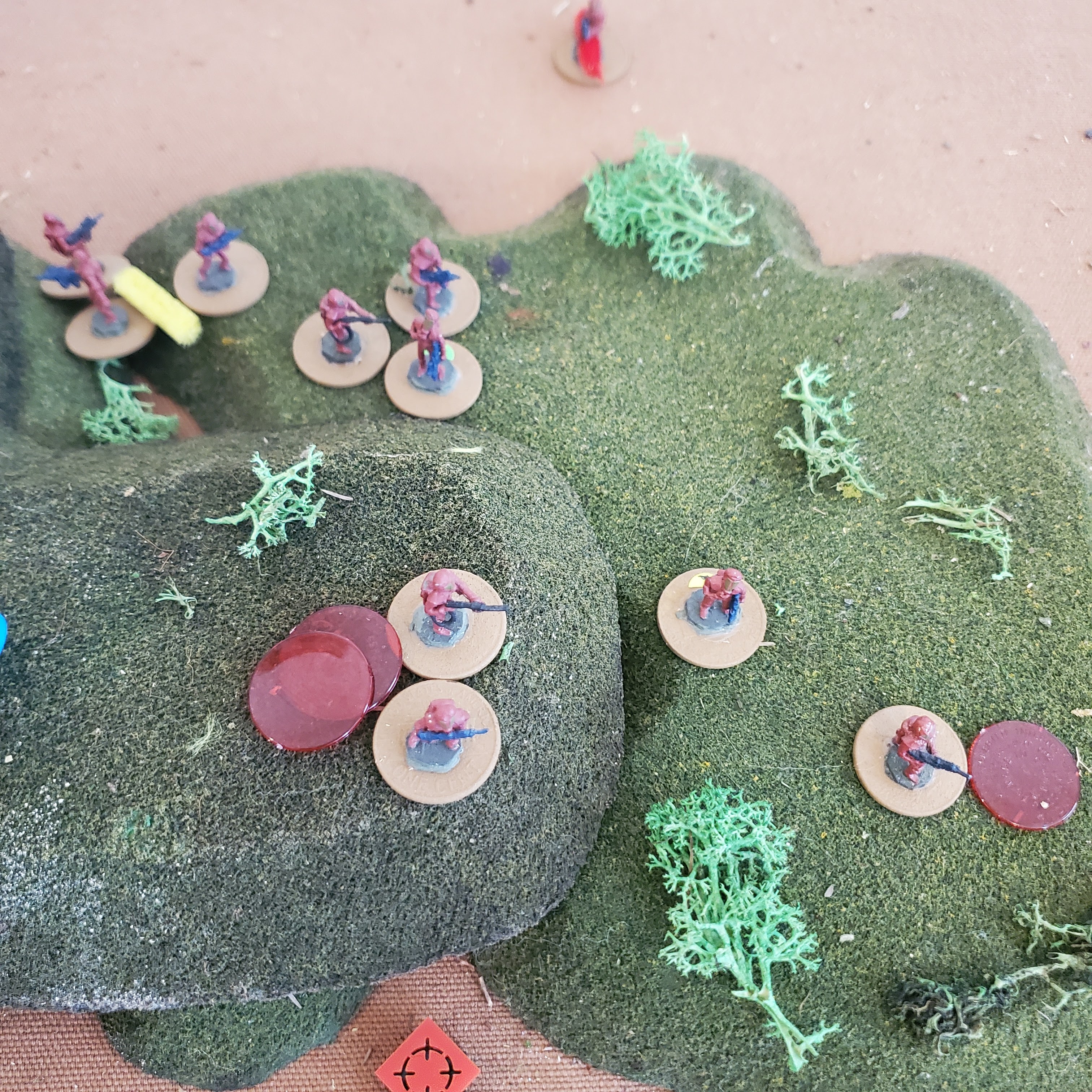
The defending Zhodani conscripts [dark red figs] deploy two squads forwards at the crest of the plateau and one on the left flank; the fourth in reserve. Another very small reserve team made up of the PL and a couple of trigger pullers is to the right rear. They could have deployed with fewer figures up front, and worked on spotting the enemy. This might have enabled the attackers to maneuver sooner, and faster, so I went with the assumption that they are playing cautiously and are also not concerned about artillery fire [like the book narrative].

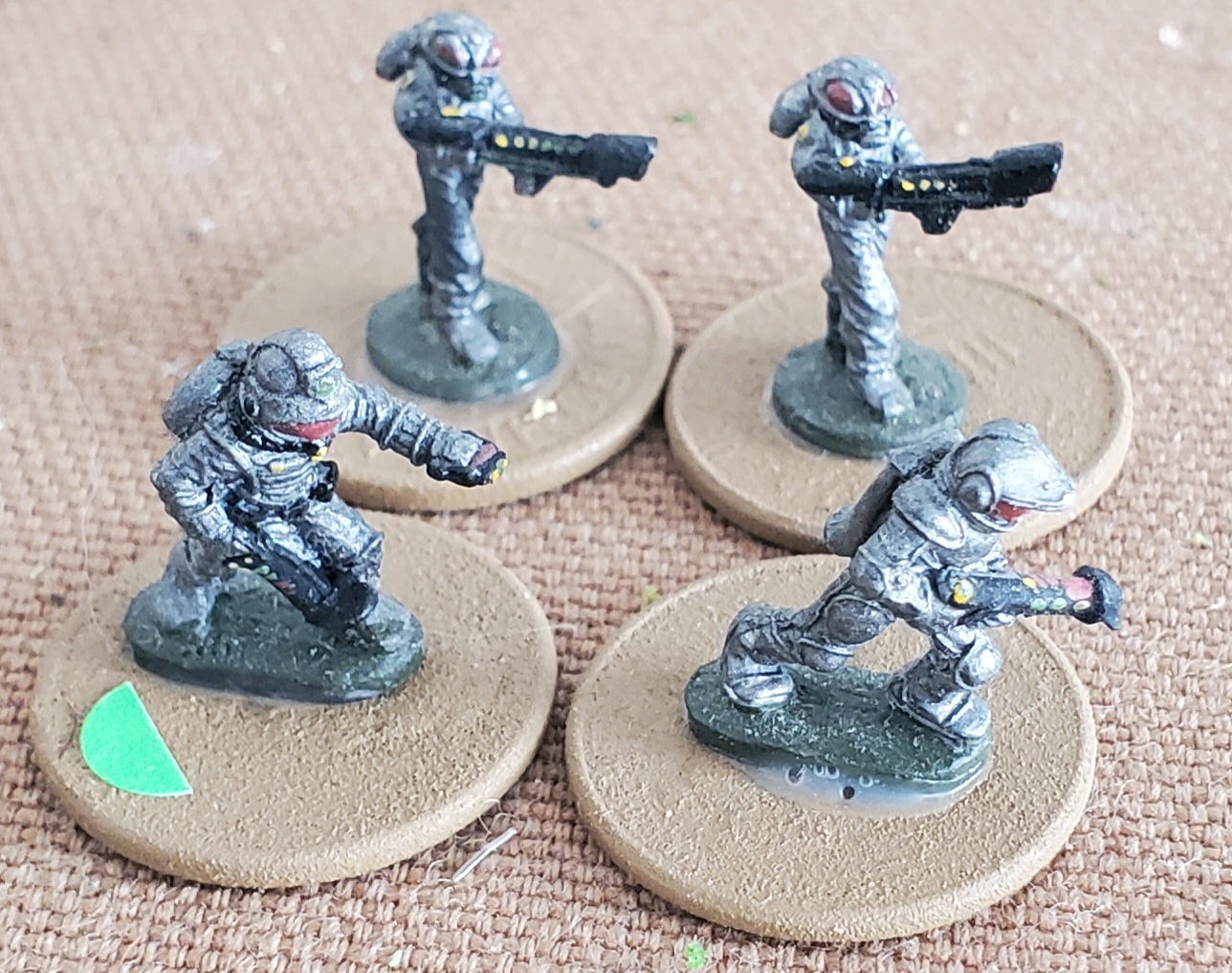
The mercenary Strikers [grey figs] have three Teams to pin the Zhodani front, while two Teams outflank them from the right.

After Blue Move phase, spotting of all Units takes place. The mercs spot a couple of Teams and the Zhodani one merc Team. In true wargame fashion, both sides decide to 'unleash hell' and Fire everyone at the spotted Teams. End result, 1.5 Zhodani Teams are beat up [and one flees], but the mercs also have one Team get beat up.  
Their left flank is still holding on, however!


However, in subsequent Spotting and Fire phases, more of the Zhodani are spotted. They slowly lose the struggle for Fire Superiority. Two more Teams are shot up, and another flees. At this point, 50% of the Zhodani force is off the line. From the front, most of the damage is from the Discarding Sabot rounds of the ACRs, while from the flank a volley of Rifle Grenades took out most of a Team, pinning the survivor.
Altho the mercs have taken one loss and a few Light Wounds....
and the flanking force isn't looking too great, after some hot rolls by the Zhodani.

But in the Panic Morale Check Phase, some more of the Zhodani Fall Back or are Forced back.

The mercs get some hot shots in, also, which tears up most of the Zhodani in the front line.

Turn 2 ends with a couple of Routs by Zhodani Team remnants, and these carry off a few more personnel. With no one manning the front line, the mercs can now easily advance and start "alpha-striking" the last few Teams and panicking troops, so the Zhodani wisely decide to fall back, reporting that they have met then enemy and retreated in good order, carrying their wounded after a heroic defense.

This fight went down in a similar way to the previous, altho the mercs took more casualties this time. Three Seriously Wounded and three Lightly Wounded, largely due to good Spotting and Fire rolls by the Zhodani.

Again, nothing wrong with how this went down. As a campaign game, assuming the mercs were the Player Characters, this would be fine. As a wargame, I think the Zhodani need an advantage or two returned to them, perhaps taking Camouflage away from the mercs, or having them start out of Line of Sight and have to Move up [this gives the opponent a bonus to Spot figures in Concealment].

Substituting the entire scenario for, say Cold War 'Nam or Germany, or a bit further forward into the present era, could easily be done. Then [in our minds] the Strikers would be US forces and the Zhodani insurgents / guerillas. I'd then reduce the weapon and armor of the Zhodani, and give the US the grenade launchers.

The likable thing about Striker is that it is very easy to shift it into different historical time periods with nothing more than a change of figures and weapon categories. Or, into a future that hasn't occurred yet, or the distant future.

This is pretty significant, as learning and re-learning new games and rules is a drain of time and energy. Striker 1e provides plenty of nuance in a single game engine, and if you also have Traveller 1e [the free / cheap white book] you can easily add a narrative, or toss in Book 4 Mercenary for a lot more depth as well as a campaign.

Oddly, perhaps, the thing I want to do next is fight my British and my Italians in the desert using this rules set, and see if Striker feels good in an historical context that I've gamed a lot.

So... Stay tuned!


Monday, February 10, 2025

Traveller: Striker 1e Playtest!

A long time ago in a galaxy far, far away...


STRIKER
WARS


AN UP THE BLUE! LIMITED 
Production


Well, to me, it is OK to mix genres that entered my little young life at around the same time - 1980-ish. It is likely that I bought the game [or convinced mom to buy it for me] because of the box image and description, and it was certainly at the old Allied Hobbies at Montgomeryville Mall in Montgomeryville, PA, USA, where it was purchased:

Like many wargame projects from middle school, I found myself a bit overwhelmed at the complexity of the rules, commitment to sports and that fascinating discovery... girls!  Still, the sci-fi genre was firmly established as a creative outlet orienting around the future. Nevermind that so little of it makes any sense realistically or scientifically or what have you - stories get TOLD in the Far Future, whether it is A long time ago or 5,000 years into the future in the Traveller Universe.

Below, Ral Partha and Martian Metals figs, mercs and Zhodani respectively.  I painted them at the time with Testors enamels, and today they are mounted on bases that cost exactly 1 cent!

It was a long time coming, with several false starts - I would read through part of the books, then find that as much as I LOVED the first several pages, including the strong narrative of a game, I couldn't push on into the mechanics. 

The last strong attempts were made in spring of 2020, during "The Late Craziness" as I like to call it [CLICK], followed by a break of at least two years. Then, there was a sudden, unexplained urge to get into 1e Traveller in winter of 2023 which pushed me to get moving on my Striker forces [CLICK]. That has gone quite well, and with regular forays into the Traveller-verse I finally built up enough drive to [again] pick carefully through the rules and create a Player's Aid, which I find essential for these old rule sets.  And thus a 4th or 5th draft that was workable was completed:
...and it only has a few key items that were overlooked, which will be corrected - more on this anon!

With a draft in hand, and some encouragement and assistance from similarly afflicted gamers over at the Fb page [CLICK], I finally found the stars aligning [pun intended] to throw down an initial playtest. I used Scenario #7: Flank Attack from One-Hour Wargames by Neil Thomas. While there are MANY scenarios suitable for modern combat in that amazing book, this one suited my availability and the CONOP that was in my mind: a small force of 20 Strikers against 37 Zhodani Home Defense Soldiers. 

As I was putting the scenario together, I then realized I needed a worksheet, one that I would continuously refer to and create from. This is due to the ruleset ultimately being an elaborate tool for a Traveller RPG Referee / GM. This was also done, with the momentum picking up as I got closer and closer:
This involved quite a bit of work, as a first-timer with the rules, to decide on weapons that were different from each other but comparable in lethality and range, along with armor, organizing squads and teams, etc. Going forward, it will be a lot easier to use the worksheet as well as modify the weaponry.

What yet *another* task complete, I put the forces onto the table, impatiently tossing some adequate and unimpressive terrain down so I could FINALLY get this 40+ year project going!  And here we go...


Scenario #7 is quite simple: two equal forces face each other, one on a large, strongly defended hill that is pinned by enemy to the front while a flanking force attacks on the right flank [shaded area]. As this did not suit my figure collection, or my desire for an asymmetric fight, I created a Zhodani Home Defense Conscript force of two Sections, 37 figs in four TL 12 Squads.  S1 top, S2 bottom, PL to left.
And a quick close-up of the Martian Metal figs. They are solid, not spectacular.

This faced a smaller attacker composed of 20 Picked TL10 mercenary Strikers [how fitting!]. I organized them into a Section of 2 Squads. Top is Squad 2, average quality to be the base of Fire, bottom is Squad 1, High IN to maneuver better:
At center is the PL with some more shooters. Bottom is the Assault suits:

Below is the Platoon Leader with a Team:

Below are the shooters for the base of fire. Great sculpts, as you'd expect from RP!

This match-up is very much in the theme of the rules, as well as making things interesting. Can a smaller, lower Tech Level force win a fight against a larger, higher TL force that is almost twice as big? Let's see how the Striker 1e engine works here!

I set up per the scenario, with all Zhodani upon the hill, altho I gave them a likely deployment of two teams covering the road, with the PL's Team and 1 Squad in reserve, back of the plateau. 1 Section below, 1 Squad back, 2 Squad up:

2 Section on the right, with 1 Squad top of hill, 2 Squad covering the road. Behind is the Rally Point, the 2nd Transcendental Center of Elbiz, in the Sword worlds.
I also decided to give the Zhodani Camouflage, a penalty of -2 to Spot them. Until you Spot the enemy, you can only use Recon by Fire, which has a large penalty.

For the attacking Strikers, I put the base of fire on the small hill, three teams to pin down the Zhodani Home Defense Force:
This included 2nd Squad and the PL's Team.  1st Squad is prepared to attack the Flank from the cover of concealing terrain.


For terrain, all hills and the two templates, and all green bushes are Concealment. This gives a 1 bonus to troops in them for morale, and a 1 penalty for Spotting and Fire against them. More importantly, it prevents them from being automatically Spotted, which turns this into a deadly game of shoot'n seek! 

The fight developed gradually. 
As all were Concealed and Stationary, they needed an 8+ on 2d6 to Spot each other at least; the Zhodani were also Camouflaged, which made it a 10+! This would drop by 2 for either side if the Team Fired. Interesting point of dice-rolling friction, the Zhodani failed to Spot any Merc Teams [abysmal rolling, a 3, 5, and 6] while the Mercs managed to Spot one Zhodani Team, rolling an 11! They proceeded to Hit 2 and Forced Back the other 2. Immediately, I noticed that Recruits were easily Removed on any Wound, Light or Serious. "I got an owie - bye!"

Having fired upon the Zhodani, their Spot number went down to 6+, and the Zhodani managed to spot 1 [ONE!] Team. This team withstood the Fire quite well, taking one Light Wound. In Turn, the Mercs then began to Spot more and more Zhodani, as they were Firing, so were an 8+ to Spot. 

The Fight then quickly escalated!
After 2-3 Turns, the Zhodani and Mercs had a solid firefight going across the valley. But the combination of higher individual Quality and Team Initiative Forced Back or Routed 3 of 4 Z Teams from the fight - and the 4th was Suppressed. The Mercs sustained a Serious and Light Wound, not much to attain Fire superiority and inflict 13 casualties! 

As a result [below], the Zhodani had to use a Code Word ["Ephemeral"] to start the advance of their Squad 1 reserve, and the PL with his Team of 3.  This gave the Merc Squads confidence to also Move up using Code Word "Starbird".

This turned out to be a bit of an error - by moving 4/5 of the Merc Teams, they lost their Overwatch / Defensive Fire, and made it too easy for the Zhodani to advance as well. Below, 2 Squad's advance:

Below, 1 Squad's advance to the edge of their Concealment.

Below, the last Team of 2 Section is encouraged to see the PL's Team advancing!
...While 1 Squad fills the gap left by 3 Squad's hasty retreat! A Suppressed Team is all that is left opposing the Merc advance into the valley.

Below, remnants of 3 Squad, lightly Wounded Regulars.

Another Turn sees the Zhodani reserves in position.

But so are the Mercs! First Squad below...


...and second squad.  Advancing put their ACRs into Effective Range. 


The game requires markers for status, or use of a roster. This greatly enables it to feel more real, but some don't like markers or rosters. Rosters is likely easiest, fastest and most realistic - you can keep hidden info hidden from opponent. 

This time, it was easier to spot everyone, as the rolls were 6+ due to the Moving. Another sharp firefight developed, and the Zhodani again got the worst of it. This resulted in several more Wounded Soldiers, and several more Routs.

As I didn't have a "Force Morale Check" number in mind, I just conceded for them when only the Elite and Veteran Leaders were left, with the PL Seriously Wounded.

This was a fascinating playtest!  A simple firefight in the brush, looked and felt very realistic. Definitely made me think - "army".

Positives:
- GREAT FEEL! The varied wounding of Soldiers helps you to realize how a few people hold a small Unit together and keep fighting while others leave. This is clearly designed for the RPG Gamemaster / Referee, and is similar to the possibilities latent in Larry Brom's "The Sword and the Flame", where they encourage you to run a platoon of 20 men all with names, tracking wounds, etc.
- Weapon capability shapes decisions and tactics. Their relative effectiveness does also. The Zhodani 4mm Gauss rifle outranged and out-powered the TL10 9mm Advanced Combat Rifle; the Mercs had to use Disposable Sabot rounds to counter them. They need rifle grenades [next fight!].
- Detection and Spotting. The Spotting mechanics shape a firefight's development; this also gives great feel
I was hoping that the Zhodani weapons would enable them to hang tough, but the opening 5 v. 3 Teams firefight went decisively in the Mercs favor due to spotting rolls and the Wound rules. 
- The Order rules force you to actually make a plan ahead of battle [just like real life]. To some extent, this is aided by Code Words. But again, there's great feel when the Leader giving the Code Word and the Unit(s) receiving it have to do *nothing* else. You can imagine the guy ordering "Cease Fire, Cease Fire!  Codeword *Hawk* Execute!" or something.

Negatives:
- The game is status marker heavy... there are ways to reduce this, but probly a roster will be a must [this also more realistically conceals info from opponent] 
- The rules are text-heavy with no bullets. I made a Player Aid / summary sheet.  The good news is that if you don't make it complicated with lots of gear and gadgets, it won't be very complicated; once you've played a certain matchup, it's a lot easier. You can gauge your game play and target audience - if they like the nuance of gear, it's there. If not, you can make a scenario as simple as the one in the book.
- They play best cooperatively, or with a referee for optimal "feel".
- The rules are a bit demanding
OTOH, they reward the time and effort put into learning them and the nuances of gear / tactics interacting.  I like this, some prefer more "game in their game" and want this abstracted. However, simpler games can become repetitive unless there's an RPG / Character aspect, or interesting scenarios are brought forwards.
- The RPG aspects require more time / effort to manage. Presently, there is no way in the rules to not use them. One has to modify it like any diligent GM.

Overall, it felt quite real, partially because there's a lot of professional instead of "game" language in the rules, but also because it is a more granular game: you game out the wounding and removal of Soldiers, the relative effectiveness of weapons, and Spotting is important - you can get some free chicken with good spotting rolls, but then you have to work that advantage into Fire Superiority. Just like real life, at certain Tech Levels the battlefield becomes a bit "empty" and detection is a significant issue. This can be aided with gadgets like Infra-red, etc.

The total experience of getting this game going reminded me a lot of my mom's cooking. She was a serious cook, and used old-school complicated recipes from Betty Crocker. Sure, it takes more work up front to make Beef Wellington with Napoleon's for dessert. However, it is more flavorful to be eating Waterloo! This is just what this game was like - flavorful.

Basically, the RPG aspect gives it a lot more "feel", and pressure the gamer / PL to push on to get into better range, better terrain, work for Fire superiority, maneuver against the objective, etc.  While they represented a fair amount of work for me to set up and execute the first time, it will be only a small fraction of that effort next time, and there WILL be a next time, I assure you!

Saturday, February 11, 2023

Traveller - A Bold Old Frontier

Time to get Travellin'!


For about 40 years, I've had the three books of the Striker Rules and Traveller Book 4 Mercenary laying around. I've always wanted to do something with them, but finally, in a motivating drive of nostalgia I pushed to get fully into Traveller 1st Edition as a combination nostalgia project and full-spectrum game project.

Nostalgia Project
Well, what is there to say except that I never did any Traveller, but I was curious about getting into the game as a visit to 1980s, which is my 7-12 grade years. I figured the style and mechanics may be a bit dated, but wanted to check it out.

My first big break was discovering that Traveller is alive and well on Facebook, with a busy forum full of helpful people.  I was pointed towards Drive-Thru RPG and there I discovered that Marc Miller, the original designer, still has control of his IP and makes all of it available in all the editions, including 1st edition!  Most of the books go for $5 pdfs, but I got books 1-3 in the Black and White edition ...
with errata and addendum...
... for $8 as a pdf AND hard copy, then paid a few bucks to have it shipped; it quickly arrived  in the white book above left.  This gave me an easy intro to the game system at low cost.

Reading the rules wasn't too difficult - the style and layout is a bit old-fashioned, but hey, I'm used to that!  I quickly realized that for an experienced gamer, even the first edition is a treasure-trove of great mechanics and useful stuff!  Books 1-3 have everything you need to create your own adventures in space, from characters, to combat, to space ships [and the *economy* of space ships] to space fights to world building. Many of the mechanics are tried and true and old enough at 40 years that they are pretty much new again!  Books 1-3 come with engaging and interesting mechanics for everything, and the combat and space combat rules are solid.  More on this in the future. But basically, with these rules, you could play almost any skirmish game period you want.

Full-Spectrum Game Project
Looking to get even more into the mood, I went to the Traveller Wiki [CLICK] for sci-fi novel inspiration in the Recommended Reading section [CLICK].  A raid of the local county library index found some of the old classics they recommended. I read three of them as I continued my quest to 'get into the game'.
 

Next, I started looking for more of the LBBs [Little Black Books] which flesh out the Character "classes" which are really branches of Service: Merchant Marine, Scouts, Navy, Marines, Army, Other [ne-er do-wells and Jacks of All Trades]. They also provide supplements for various systems, adventures, and resources to run games [everything from forms to pre-gen characters, etc].  I managed to find some on-line stores with large collections they wanted to move.  As I didn't want just one book, I bargained for some great deals!


One vendor also had several boxed board games, so I got some of them with a load of LBBs for a very nice price:
The combine the Grand Strategic, Strategic, Operational, Grand Tactical and Tactical levels in one way or another.  So this is a:

FULL SPECTRUM GAME PROJECT!

Armed with these tools, I realized that I had what was quite unusual: 
- an RPG with a great set of skirmish rules
- a great set of ship combat rules, expanded in Book 5 to squadron combat,
- a universe to fight in, 
- crazy good amounts of hard-science fluff and novels
- several directly related board games
- a set of miniature combat rules I already owned [Striker - Frank Chadwick's precursor to several board game systems and his Command Decision WWII miniature rules],
- a bunch of original 15mm Ral Partha, Martian Metal, and RAFM miniatures,
- Amazing possibilities for different games with different people and clubs, including the RPG, Miniatures, and Board Game scenes.

The gaming potential is mind-blowing!  I may never be stuck without a choice of opponents ever again, and the games are just fine for solo play.

In 41 years of gaming, I've never yet successfully merged character, land battles, and naval battles, but it is finally going to happen...Time to get Travellin'!